

This series features expert-led, action-oriented explainers focused on key finance topics. The series is intended to help leaders learn about the topic, apply proven practices, and access hands-on tools that can strengthen their approach. Learn more about the series here.
Municipal debt is an avenue of public finance that governments use to raise money from investors via borrowing. Municipal debt can take many forms, including municipal bonds, notes, commercial paper, and other instruments, depending on what is authorized by law. Traditionally, governments who issue municipal debt use the proceeds to finance infrastructure projects, including schools, bridges, roads, water systems, housing, utilities, parks and more. Investors who purchase municipal bonds traditionally receive interest for the duration of their investment, and the return of principal. In the United States, municipal bonds and notes carry a tax preference: the interest and the return of principal that investors earn is tax exempt at the federal level and within the state where they reside. Intergenerational equity plays an important role in a government’s decision to issue debt.
"While funding projects using a pay-as-you-go strategy emphasizes aligning current revenues with current expenditures, debt financing allows costs to be shared across current and future beneficiaries."
Governments can issue municipal bonds when they want to raise money by issuing long-term debt. Municipal bonds are debt instruments that traditionally mature in more than one year. The maturity date often reflects the useful life of the asset being financed. For example, a municipal bond to finance municipal vehicles, such as fire trucks, may be structured to have a 5-year duration; a municipal bond to finance the construction of a building or sewer system may be structured to have a 20-year duration (or longer). The duration is based on the useful life of the asset and any restrictions from the laws that authorize the issuance and sale of municipal bonds.
Municipal bonds are secured and repaid through a combination of either general or dedicated revenue streams, including, for example, general tax revenues, tolls, and utility fees, among others. Where bonds are secured by a general or gross revenue pledge, they are called general obligation bonds. Where bonds are secured by a specific pledged revenue stream, they are called revenue bonds. Municipal bonds can be structured in a myriad of ways with features including, but not limited to, fixed or variable interest rates, call features, pricing variations, and others.
Notes are short-term obligations of an issuer to repay a specified principal amount with interest at a stated rate from a defined source of revenues or supported by a gross revenue pledge, creating a loan that traditionally matures in less than one year. Notes can be repaid from a defined source of revenues or supported by a gross revenue pledge. Commercial paper is a short-term obligation issued by governments usually backed by a line of credit with a bank that matures within 270 days. The issuer typically pays the principal of any outstanding commercial paper with newly issued commercial paper, essentially borrowing funds on a short-term basis for an extended period. Similar to municipal bonds, the proceeds of notes or commercial paper are traditionally used to fund infrastructure projects. There are limited exceptions where laws may enable governments to use proceeds of short-term debt to meet revenue timing gaps and budgetary gaps via the issuance of grant anticipation notes, deficit funding notes, and others.
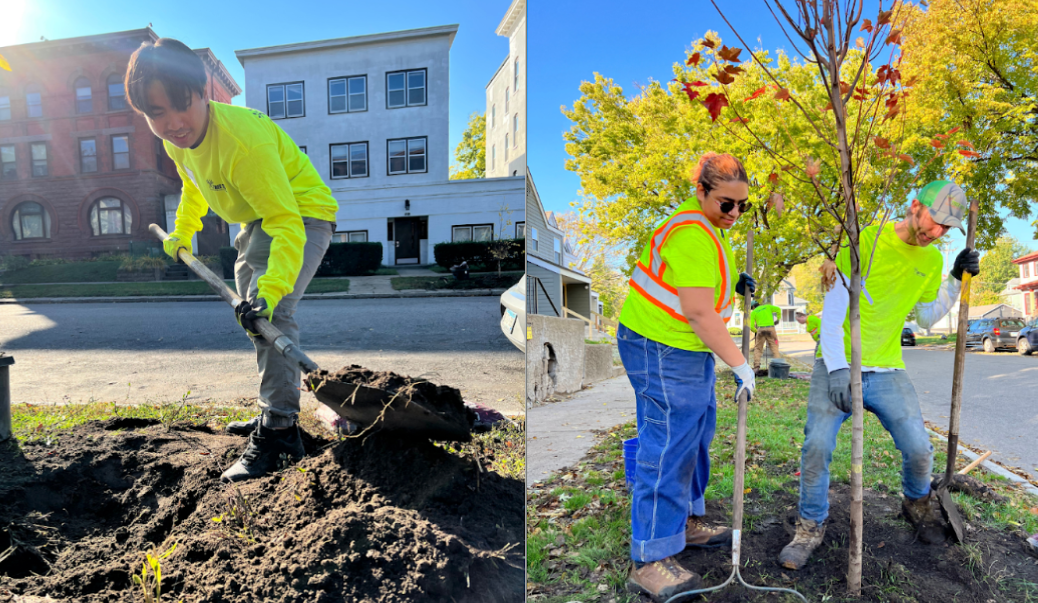
In 2022, the City of Saint Paul, Minnesota and Saint Paul Port Authority issued a Sustainability Bond to fund a citywide tree-planting initiative, treating trees not as amenities, but as long-term capital assets within a broader climate strategy that included a commitment to social justice and workforce outcomes. The bond proceeds were used to address the loss of tree canopy in many neighborhoods across the city where dead trees were stricken by an invasive insect called the Emerald Ash Borer Beetle, including neighborhoods with vulnerable populations.
The use of the proceeds for the sustainability bond recognizes the multiple climate and resilience dividends of urban canopy: cooling neighborhoods through increased shade, improving air quality by absorbing pollutants, and reducing flooding and erosion by strengthening stormwater management, all while contributing to rising property values. To align its climate strategy with a commitment to reduce environmental disparities, Saint Paul prioritized neighborhoods with the lowest tree canopy–which often were areas disproportionately home to people of color. In doing so, the city demonstrates how capital planning and climate action can be integrated to deliver both systemic resilience and more just outcomes when municipal bonds are used to raise proceeds at scale to invest in climate resilience. To read more about St. Paul in our case study series, click here.
Lourdes Germán, J.D., is a public finance leader with experience in law, investment banking, and policy. She began her career as an attorney and later served as Vice President at Fidelity Investments, General Counsel at Breckinridge Capital Advisors and a director at the Lincoln Institute of Land Policy, where she advanced municipal fiscal health initiatives with global partners. Lourdes currently leads the Public Finance Initiative as Executive Director and teaches public finance at Harvard’s Graduate School of Design.
This resource was created for educational purposes only as part of the Rural & Small Cities Program, with the support of the Robert Wood Johnson Foundation. The views and perspectives presented in this resource are those of the author and the Public Finance Initiative team. The Public Finance Initiative acknowledges staff members Katy Hansen, Richard Figueroa, and Peter Hamlin for their contributions to this resource.

